
Screen-Free Room Ideas: Why the Best Room in the House May Not Have a Screen


Somewhere along the way, the television became the most important member of the family.
Every chair faced it. Every piece of furniture was arranged around it. Entire rooms were designed to give it the best possible view—even though, technically, it is the one doing the showing.
I am not against televisions. I enjoy a good movie as much as anyone. But when every gathering space in a home is organized around a screen, something quietly disappears: conversation.
That is why screen-free room ideas are beginning to feel less like nostalgia and more like genuinely thoughtful interior design.
Homeowners are rediscovering spaces created for cards, games, reading, music and simply enjoying time together. Honestly, I think their return is long overdue.
Screen-Free Rooms Are Making a Comeback
According to the 2026 U.S. Houzz Emerging Summer Trends Report, searches for “mahjong room” grew nearly twentyfold from January through March 2026 compared with the same period in 2025.
Searches for “card room” increased 129%, “board game room” rose 45%, and “poker room” increased 38%.
Those are not small increases.
They suggest that homeowners are looking for more than another perfectly styled room. They want spaces where people can gather, participate and enjoy one another without everyone eventually staring at a different device.
A screen-free room does not have to be formal, enormous or devoted to one particular activity. It can be a family game room, library, music room, card room, conversation lounge or simply a comfortable corner where the furniture faces people instead of electronics.
The purpose is what matters.
A Room Should Encourage the Life You Want to Live

The way a room is designed influences how people behave inside it.
Place every seat toward a television, and people will naturally watch television. Arrange comfortable chairs around a table or position sofas so people can see one another, and conversation becomes easier.
Good interior design does more than make a room attractive. It quietly encourages the activities we want to happen there.
If you want your family to play games, the games should be easy to reach. If you want friends to linger after dinner, they need comfortable seating and a place to set a drink. If you want a quiet place to read, the lighting needs to support it.
Otherwise, the room may be beautiful but practically useless—which is a rather expensive way to store decorative pillows.
You Do Not Need an Extra Room

Not every home has a spare room waiting patiently to become a mahjong parlor.
Fortunately, it does not need one.
A screen-free space can be created within an existing living room, dining room, home office or open-concept area. The key is giving the space a clear purpose.
An underused dining room can become a card and game room while still functioning beautifully for meals. A corner of the living room can hold two comfortable chairs, a small table and a reading lamp. A wide hallway or landing can become a cozy library with built-in shelving and a bench.
If your home has a difficult corner, alcove or oddly shaped area, it may be the perfect opportunity. I have shared more ideas for transforming awkward spaces into useful and beautiful areas.
Even a kitchen can include a small conversation area where someone can sit without being directly in the path of the refrigerator. That last detail is important unless your idea of family connection includes repeatedly saying, “Excuse me, I need to get through.”
The most successful rooms are not necessarily the largest. They are the ones that make people want to stay.
Begin With the Way the Room Will Be Used to Create Screen-free room
Before selecting furniture or colors, decide what you actually want to do in the space.
Will it be used for cards? Board games? Reading? Music? Cocktails? Puzzles? Conversation? A little of everything?
A card room needs a table with comfortable chairs and properly placed lighting. A reading room requires supportive seating, accessible books and task lighting. A conversation room benefits from furniture arranged closely enough that no one has to project across the room like an actor onstage.
Design should begin with real life—not with a photograph of a room no one is allowed to touch.
Once the room’s purpose is clear, the furniture, lighting and storage decisions become much easier.
Let the Architecture Guide the Design

A new space should feel as though it belongs in the home.
The materials, trim, cabinetry and furniture do not need to match every other room exactly, but they should have a clear relationship with the home’s character. A sleek contemporary game room can feel disconnected inside a traditional house unless something intentionally bridges the two styles.
Understanding your home’s structure can help you create that connection. If you are uncertain where to begin, read my guide to identifying your home’s architectural style and creating a cohesive interior.
The goal is not to copy the exterior inside. It is to make the entire home feel thoughtfully connected.
Comfort Matters More Than Novelty
A screen-free room should never feel like punishment for owning a phone.
If the chairs are uncomfortable, the lighting is poor or the room feels cold, people will leave. Usually while taking their phones with them.
Choose seating that encourages people to settle in. Use upholstery, rugs, pillows and window treatments to soften the room. Include tables within easy reach. Layer the lighting so the space can feel bright enough for a game but warm enough for an evening conversation.
This is also a wonderful place to use richer colors, interesting patterns and collected pieces. Because these rooms are created for enjoyment, they can have more personality than spaces designed primarily for display.
They should feel relaxed, inviting and slightly irresistible.
Give Everything a Proper Place
Games and hobbies are much more likely to be used when they are accessible—but a family game room can quickly become cluttered when nothing has a proper home.
Custom cabinetry, built-in shelving, closed storage and thoughtfully selected furniture can keep games, cards, puzzles, books and entertaining supplies organized without hiding them so thoroughly that everyone forgets they exist.
A beautiful cabinet can store board games. A window seat can include drawers underneath. A console can hold cards, score pads and serving pieces. Open shelves can display favorite books and meaningful objects while closed cabinetry handles the less photogenic necessities.
Yes, even beautiful homes contain things that should remain behind cabinet doors.
That is not dishonesty. That is design.
Make the Room Personal
A room created for connection should tell your family’s story.
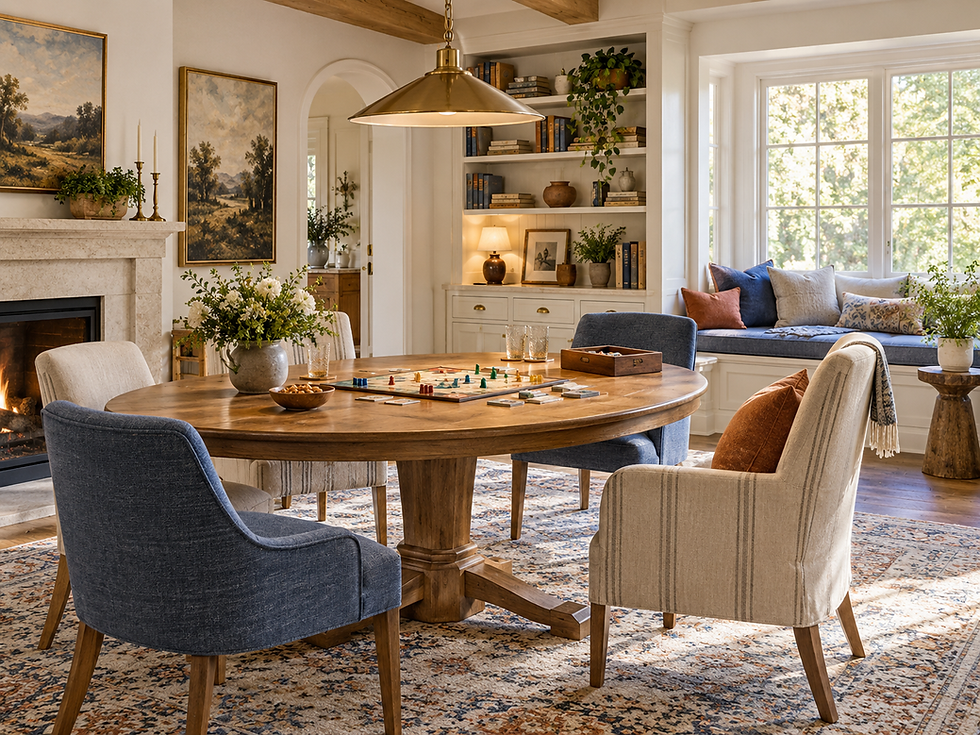
Display books you actually read. Frame family photographs you genuinely love. Include objects with history rather than filling every shelf with something selected only because it happened to be beige.
Bring out the chess set that belonged to your grandfather or the card table that reminds you of evenings spent with friends.
Artwork can establish the entire mood of a room and create a focal point that is not electronic. A piece created specifically for the room can bring together its colors, proportions and personality. Beautifully Done also creates custom paintings designed for individual homes and spaces.
Meaningful objects create conversation naturally because they carry memories with them.
This is what separates a personal home from one that looks as though every object arrived in the same delivery truck.
A well-designed room does not need to match perfectly. It needs to feel connected.
Design for Adults Without Forgetting the Children
A screen-free gathering space can work for every generation.
Children may use it for drawing, puzzles and board games during the day. Adults may use the same room for cards, drinks or conversation in the evening. Grandparents and grandchildren can enjoy the space together without needing to understand the same technology.
Flexible storage and durable materials allow the room to change throughout the day without looking childish or overly formal.
A family game room should not become another room with rules about who may enter. It should be a room people genuinely want to use.
The New Luxury May Be Undivided Attention
For years, luxury home design was associated with size, expensive finishes and the latest technology.
Those things still have value, but perhaps our definition of luxury is changing.
Maybe luxury is having a comfortable place to sit with someone you love. Maybe it is finishing an entire conversation without a television filling every quiet moment. Maybe it is hearing laughter from a card game or watching family members become fiercely competitive over a board game no one claimed to care about twenty minutes earlier.
A beautiful home should support those moments.
It should not simply impress people when they enter. It should give them a reason to stay.
Frequently Asked Questions About Screen-Free Rooms
What is a screen-free room?
A screen-free room is a space designed around conversation, reading, games, music or another shared activity instead of a television or digital device. It can be an entire room or a thoughtfully arranged area within a larger living space.
Do I need a separate room to create a screen-free space?
No. A dining room, unused corner, wide landing or part of an open-concept living area can become a screen-free gathering space with the right furniture placement, lighting and storage.
What should a family game room include?
A successful family game room should have comfortable seating, a properly sized table, layered lighting and accessible storage for games and supplies. The materials should also be appropriate for the way the family will actually use the space.
Can a screen-free room still feel sophisticated?
Absolutely. A game or card room can include beautiful upholstery, custom cabinetry, original artwork, layered lighting and elegant finishes. The room’s purpose can be playful without the design feeling childish or themed.
Can an interior designer help create a screen-free room?
An interior designer can evaluate an unused room or awkward area and develop a plan for furniture placement, lighting, storage, materials and artwork. This helps the new space feel functional while remaining visually connected to the rest of the home.
Creating a Screen-Free Space in Your Northwest Arkansas Home
Whether you have an unused room, an awkward corner or an open-concept space that lacks intimacy, thoughtful interior design can turn it into a place for connection.
Beautifully Done helps homeowners throughout Bentonville and Northwest Arkansas create interiors that reflect the way they truly want to live. From furniture placement and layered lighting to custom cabinetry, original artwork and finishing details, every element can work together to make a room feel intentional and inviting.
Your home does not need another room no one uses.
It needs a room where life actually happens.
If you would like help creating a family game room, card room, library or screen-free conversation space, schedule an interior design consultation with Beautifully Done.
The best room in your house might turn out to be the one without a screen.
Life is More Fun Beautifully Done 🦋


Comments