
Why Interior Design Should Respect the Architecture of Your Home

By Trish Whitsell | Beautifully Done Interior Design
Understanding how modern or traditional architecture influences the interior design of your space can be confusing I hope this little blog post helps you to understand the relationship of exterior and the interior of your home. Interior design should begin with the architecture. Before choosing a sofa, replacing a fireplace, or ordering a light fixture, we need to understand the rooms we are designing.
I believe decorators do homeowners a disservice when they recommend a fashionable look without considering whether it belongs in their home. Calling something “updated” does not explain why it works. A beautiful piece can still be the wrong size, shape, or visual weight for the room around it.
My guiding principle is simple: to the architecture, be true.
Remember what attracted you to the home

Perhaps it was the arched doorway, the warmth of the woodwork, or the way the fireplace anchored the living room. Those details may have helped you fall in love with the house. Before changing them, ask whether the proposed design preserves what you valued.
Of course, people also buy homes for their location, price, or practicality. They may want substantial changes. That makes an honest conversation about the architecture even more important. What should remain? What needs to function differently? What can change without leaving the house feeling pieced together?
Designer Trevor Fulmer makes a related point in his writing on timeless renovations: contemporary furniture and lighting can work within older architecture when the relationship between them is considered. Respecting a building allows it to evolve.
It helps to distinguish the features that define a home from those that happened to be there when you bought it. A distinctive stair railing or original wall paneling may deserve careful attention. A dated ceiling fan or a later light fixture may be much easier to replace without changing the character of the house.
I would begin by looking at the home before shopping for it. Notice the ceiling heights, the shapes of the openings, the thickness of the trim, and the way one room connects to another. A house may combine influences rather than fit neatly into one style. The goal is to understand what is actually there instead of assigning a label and treating every room the same.
Why a decorated room can still feel wrong If One Doesn't Follow the Rule: Design Should Respect the Architecture
You can walk into a room and feel that something is off without being able to name the cause. The furniture may be attractive and the finishes expensive, yet the room still does not feel pulled together.
Imagine a substantial traditional fireplace beneath a tall ceiling, paired with a tiny light fixture and low furniture that visually disappears. Or picture a formal wall with matching windows, where a bulky cabinet overwhelms one side. These are examples of scale and balance problems, not proof that one furniture style is automatically wrong.
Scale describes size in relation to the space. Proportion concerns how the parts relate to one another. Balance concerns the distribution of visual weight. Color, shape, texture, and placement all affect that weight. We need to consider the entire room rather than approve every purchase in isolation.
A room can also have too many competing focal points. Imagine a patterned fireplace surround, a dramatic accent wall, a heavily veined countertop, and a statement light all visible from the same doorway. Any one of them might be lovely. Together, they may demand equal attention and leave the eye without a clear place to settle.
In that situation, I would decide which feature should lead and which should support it. That might mean choosing quieter surrounding finishes or moving a decorative piece. The answer depends on the room. Adding another accessory before understanding the problem can make the composition even harder to resolve.
Symmetry matters but balance comes in different forms
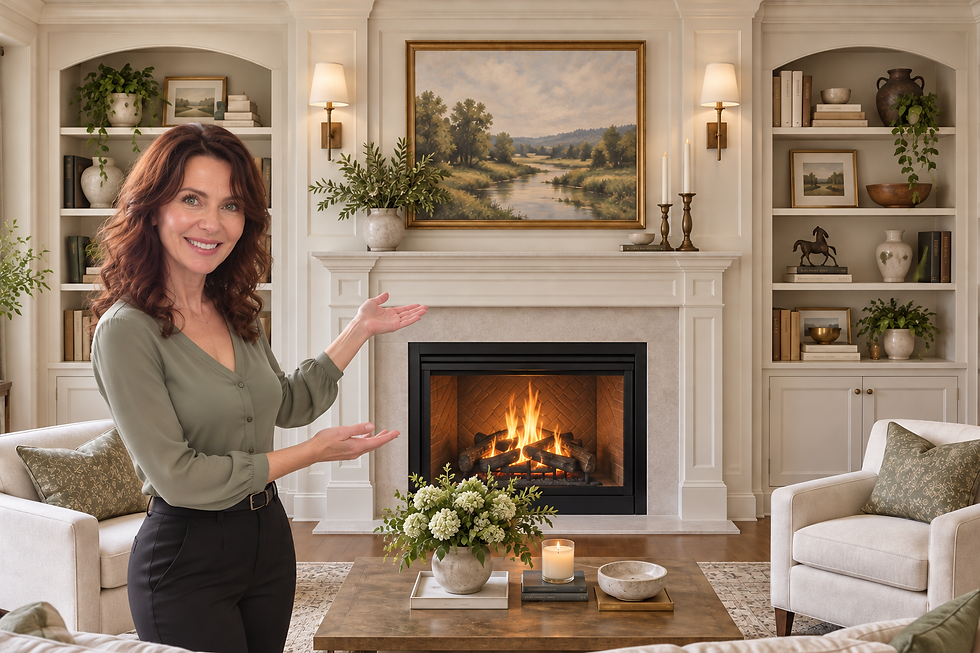
Symmetry creates order by arranging matching or similar elements around an axis. When architecture establishes that order through paired windows, matching built-ins, or a centered fireplace, the decorating plan should recognize it.
But traditional homes are not always symmetrical, and good interiors do not require everything to match. Asymmetrical arrangements can also feel balanced. A substantial chair might be balanced by a grouping of smaller pieces rather than an identical chair.
Jamie House Design distinguishes balance from symmetry in its design journal. Designers featured in Homes & Gardens also show how symmetrical architectural features can support contemporary furnishings and more relaxed, asymmetrical styling. The lesson is to understand the existing composition before changing it.
A centered fireplace does not mean every object in the room must be mirrored. It does, however, give us an architectural reference point. A furniture arrangement that acknowledges that center can feel settled even when the chairs, side tables, and accessories differ. If the layout shifts away from it, another clear organizing idea needs to explain the shift.
Existing architecture also has practical constraints. A doorway may prevent matching furniture arrangements, or a window may leave less usable wall space on one side. Trying to manufacture perfect symmetry can interfere with daily use. A trained eye considers how the room looks and how people will move through it.
Modern furnishings can belong in a traditional home

I love the possibilities of introducing contemporary pieces into traditional architecture. A clean-lined sofa can give decorative molding room to shine. Abstract art can add energy above a classic mantel. A sculptural light can become a thoughtful focal point when its size and placement suit the room.
The connection might come through a repeated material, a shared color, a complementary curve, or carefully balanced proportions. The same care allows traditional furnishings to work within modern architecture. The pieces do not have to come from the same period to feel comfortable together.
A traditional home can also be furnished predominantly, or even entirely, with modern pieces and still be successful. The architecture can provide the traditional layer. There is no universal percentage of modern furniture that makes a room fail.
What concerns me is imposing a look without resolving its relationship to the building. Removing distinctive details, adding unrelated permanent finishes, and ignoring the room’s proportions can leave a home feeling disconnected. A modern chair is a very different decision from permanently altering the architecture around it.
Consider a traditional room with substantial wood trim and a classic mantel. Contemporary upholstery in a warm, textured fabric might relate comfortably to those materials. A simple coffee table could provide relief from the more detailed architecture. Repeating a color from the artwork in a cushion can help the newer pieces feel connected without making everything match.
The reverse deserves equal care. An antique wood chest can bring warmth to a modern room with simple walls and large windows. Its placement, size, and surrounding space determine whether it feels thoughtfully included. Filling the same room with unrelated ornate pieces could compete with the simplicity that made the architecture appealing.
These are possible approaches, not recipes. A piece can be appropriate in one house and awkward in another. That is why I prefer to evaluate furnishings in relation to the actual room rather than approve them solely because they look beautiful in a showroom.
Breaking design rules takes a trained eye

Design principles give us a dependable starting point. They help us evaluate furniture placement, focal points, repetition, proportion, and circulation. They are useful because they give us reasons for our choices.
A trained eye understands what those principles accomplish before deciding to depart from them. That understanding develops through study, practice, and careful observation. It allows a designer to judge whether an unexpected choice strengthens the room or simply makes it feel unsettled.
These principles are not foolproof formulas. Rooms differ, families live differently, and a good solution needs judgment. Experienced designers sometimes depart from familiar guidelines because another arrangement serves the space better.
If we choose an unexpected layout, we should be able to explain how it supports the room. Where does the eye settle? What balances the largest piece? Can people move comfortably? How does the arrangement relate to the windows and fireplace?
“I’m breaking the rules” is not an adequate explanation for a result that has not been thought through.
For example, using two different bedside tables can be successful when their heights, visual weight, and relationship to the bed are considered. Simply purchasing two unrelated tables because matching is supposedly outdated does not accomplish the same thing.
The same applies to an intentionally oversized light fixture. A bold choice can work when its size suits the room and it leaves the clearance needed for everyday use. Calling an awkward fixture a statement piece does not resolve those relationships. We should be able to explain the choice in terms of the room and its use.
Permanent changes deserve a closer look

When a design changes the building itself, I want a stronger explanation than “this is what everyone is doing.” A fireplace surround, a wall opening, or a run of custom cabinetry affects the room long after a particular trend has passed. Those choices deserve careful study before construction begins.
For a fireplace, I would consider its relationship to the wall, ceiling, nearby windows, and furniture. For built-ins, I would look at how their height, depth, and divisions relate to the room. For a light fixture, I would consider the area it serves as well as the architecture around it. Beautiful materials cannot compensate for an unresolved layout.
Respecting architecture also allows improvements in function. A formal dining room can become a sitting room if that better serves the family. The new use should be planned around the room’s openings, circulation, and proportions. Keeping every original use is not necessary to retain a home’s character.
When work affects structure or building systems, the design also needs appropriate technical review. For protected historic properties, preservation requirements may affect what can change. The National Park Service rehabilitation standards provide a useful example of retaining distinctive character while allowing compatible adaptation; they are not blanket decorating requirements for every home.
Clients deserve more than reassurance
Whether someone calls themselves a designer or a decorator, the work should be evaluated by the reasoning behind it. A professional title alone does not guarantee architectural sensitivity.
It is irresponsible to dismiss a homeowner’s concern that a room feels awkward without examining the cause. Clients deserve a clear explanation of the proposed choices, especially when those choices involve costly or permanent changes.
Before approving a design, ask which architectural features it respects, why the scale works, and how the room will function. If a distinctive feature is being removed, ask what the home gains and what it loses.
My approach at Beautifully Done Interior Design is to begin with the home and the people who live there. For homeowners in Bentonville and throughout Northwest Arkansas, that means creating rooms that reflect personal taste while making sense within the architecture.
If you are planning an update, visit beautifullydone.design to start a conversation about a design that suits both you and your home.
Sincerely,
Trish
Life is More Fun Beautifully Done 🦋



Comments